
SMS Patient Billing: Is Text-to-Pay HIPAA Compliant?
Today’s patient expects the same level of convenience from their interactions with healthcare providers as they do from other services and retailers—but what they may not realize is that there are more regulations and hoops to jump through for healthcare payments.
While text-to-pay is possible for patient billing, these additional obstacles mean that many medical providers and hospitals are hesitant to implement it, making healthcare lag behind other industries that have been more nimble in implementing new technologies. With concerns about HIPAA compliance, data security, and reliability, it’s easy to understand the hesitation, but with a competent partner, text-to-pay is safe, secure, compliant, and a boon to patients.
Below, we address the most common FAQs providers and patients have about SMS Patient billing, specifically text-to-pay.
Is Text-to-Pay HIPAA Compliant?
Let’s start with the most important question, because without HIPAA compliance, the discussion ends here. The short answer is that text-to-pay can be HIPAA compliant, but it must be done correctly.
While HIPAA doesn’t prevent healthcare providers from texting patients, it does set standards for how protected health information, or PHI, is accessed, transmitted, and secured. Given this, text-to-pay messages should not include any sensitive information: patient diagnoses, details from appointments and procedures, or insurance information.
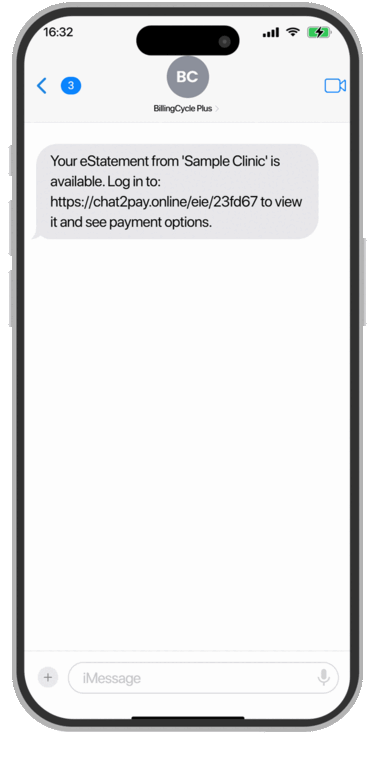
Compliant language is neutral and includes phrases like “You have a new statement available” or “Your balance is ready to view.”
Then, the text message will include a secure link that directs the patient to a secure HIPAA-compliant payment portal. In this portal, more sensitive information can be displayed, as it is protected by encryption and authentication.
Do Patients Need to Provide Consent for SMS Patient Billing?
Yes, patients must opt in to receive SMS billing communications. Healthcare providers can ask for consent during initial patient registration or when patients visit their patient portals. Whether the authorization form is in print or electronic, it should be clearly written, easy to understand, and offer instructions for opting out of text messaging.
HIPAA allows patients to choose their preferred method of communication, even if that method carries some level of risk (i.e., leaving a voicemail on a shared phone line), as long as they are informed and provide consent. Many patients prefer text messages, but we always recommend a “click-and-mortar” approach that offers both analog and digital payment options.
Is SMS Billing Secure Enough for Healthcare?
In short: yes, SMS is secure enough for healthcare billing. This question misunderstands the meaning and implementation of text-to-pay.
“Text-to-pay” is a bit of a misnomer, as it doesn’t involve submitting actual payments via text, and as discussed above, it should not contain PHI. Instead, SMS is used to send reminders with links to secure portals for payment. There is no sensitive information in the messages; in fact, printed statements typically reveal much more patient information than SMS.
Will Patients Trust Text-to-Pay Messages?
Anyone with a phone has likely received countless scam texts asking for payments for highway tolls, packages with postage due, and so on. In light of this, many healthcare providers worry that patients will overlook billing texts, assuming they are scams.
It’s true that some patients will be better served by print billing statements. But with proper informed consent, clear branding, consistent language, and predictable timing, most patients will learn to trust text-to-pay notifications. Many patients already use similar payment options for utilities and other services, so when healthcare providers can implement text-to-pay in a similar fashion, patients are more likely to engage.
Does Text-to-Pay Replace Printed Statements?
We don’t recommend replacing print statements with text-to-pay. Instead, text-to-pay works best as part of a hybrid billing strategy. An initial printed statement helps establish legitimacy and provide an “official” record. Subsequent SMS messages serve as reminders and provide a convenient means of making payments.
We recommend timing the first SMS to arrive shortly after the print statement, as this allows patients to take prompt action while their medical bill is top-of-mind. This reduces the number of late payments and shortens the time in accounts receivable; it can also reduce the number of billing inquiries and calls, freeing up staff time for more important tasks.
Is Text-to-Pay Effective?
Yes, in our experience, text-to-pay, when paired with complementary print and email messaging in a hybrid strategy, is highly effective.
Text messages have higher open rates than email and are usually read within minutes. Even setting aside the patients who have trust issues—typically, older patients who aren’t as familiar or comfortable with mobile devices—healthcare providers who use SMS see improved engagement and faster payments.
With more patients bearing an increasing financial burden of their healthcare, text-to-pay is an excellent way to remove friction from the payment process, allowing people to pay wherever they are, rather than having to find their checkbook, pay for a stamp, and drop their payment in the mail.
Text-to-Pay: An Important Tool in Your Medical Billing Arsenal
When implemented correctly, SMS patient billing is HIPAA-compliant and protects sensitive payment and patient information by directing patients to a secure portal to pay their bill.
MailMyStatements offers HITRUST- Certified hybrid billing solutions that include SMS, printed statements, and email to meet patients where they’re at. Schedule a demo today to learn more about our offerings.

Related Posts
The Click-and-Mortar Approach: Balancing Digital Billing with Paper Statements
As more and more healthcare providers transition to patient portals and online billing, there’s an…

5 Strategies to Improve Patient Self-Pay Collections
Healthcare finance leaders today face a growing challenge: collecting self-pay balances without eroding patient trust.…

Adapting to Value-Based Care Models: Implications for Patient Billing
The transition to value-based care marks a fundamental shift for patients, insurers, and healthcare providers…