
Top 7 Elements of a High-Converting Patient Statement

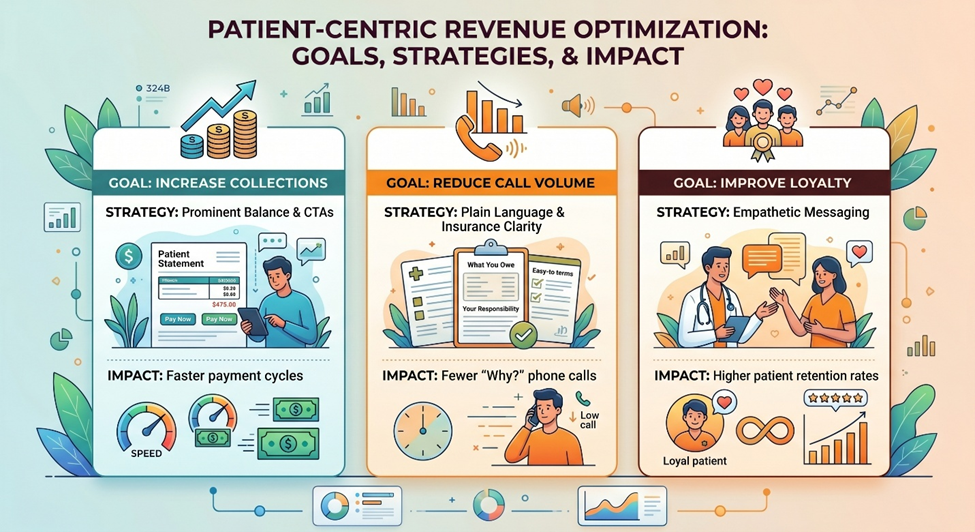
Patient statements are often treated as the final, administrative “afterthought” of a clinical encounter, but in reality, they are one of the most high-stakes touchpoints in your entire revenue cycle. In an era where patient responsibility has reached record highs—with some data suggesting that out-of-pocket costs now account for nearly 35% of total provider revenue—the statement is no longer just a request for payment. It is a communication tool that can either build a bridge of trust or create a wall of confusion.
A poorly structured statement doesn’t just sit on a kitchen counter; it triggers expensive phone calls to your billing office and delays your cash flow. If your goal is to boost collections while maintaining a positive patient experience, your statements must evolve.
Here are the seven essential elements of a high-converting patient statement, backed by current industry data.
1. Clear, Simple Balance Information
The most critical piece of information on any statement is the “Total Amount Due,” yet it is often buried under a mountain of clinical codes and dates. To maximize conversions, this figure should be the “North Star” of your document, highlighted prominently in a high-contrast area.
Recent studies in consumer behavior show that roughly 60% of patients feel confused by their medical bills, often leading to “payment paralysis” where the patient ignores the bill entirely because they can’t verify the actual amount owed. By clearly breaking down recent charges, payments, and adjustments in a summarized view, you provide the clarity needed to move a patient from “confused” to “completed transaction.”
2. Easy-to-Understand, Human-Centric Language
Healthcare billing is notorious for its dense jargon, but your patients aren’t medical coders. Using terms like “Patient Responsibility” or “Contractual Adjustment” creates unnecessary friction. Modern high-converting statements replace technical terminology with plain language that a layperson can understand at a glance.
Instead of “Outstanding Balance,” use “What You Owe.” Instead of “Adjudication Date,” simply state “When Your Insurance Processed This.” This shift isn’t just about being friendly; it’s about accessibility. With nearly 9 out of 10 adults struggling with complex health literacy, simplifying your language is the most direct way to ensure your bill gets paid.
3. Multiple, Frictionless Payment Options
We are living in a “one-click” economy, and patients now expect their healthcare providers to match the convenience of their favorite retail brands. High-performing statements must cater to a diverse range of payment preferences, moving beyond the traditional check-and-envelope model.
Data from 2025 indicates that over 70% of patients prefer to pay their medical bills electronically. To capture this, statements should include:
- Dynamic QR Codes: Allowing patients to scan and pay in seconds via mobile wallet.
- Shortened URLs: Direct links to a secure, mobile-responsive payment portal.
- Text-to-Pay: Instructions on how to opt-in for SMS billing updates.
By offering a digital-first approach while maintaining traditional phone and mail options, you remove the physical barriers to payment.
4. A Strong, Visible Call-to-Action (CTA)
In the world of marketing, a clear Call-to-Action is the difference between a lead and a sale; in healthcare, it’s the difference between a paid bill and a bad debt write-off. Your statement should never leave a patient wondering what to do next.
Effective statements utilize “action-oriented” design, featuring bold buttons or dedicated boxes that say “Pay Now” or “View Your Payment Plan Options.” Research suggests that including a clear due date and a specific “How to Pay” section can increase payment velocity by as much as 20%. When the path to payment is paved with clear instructions, patients are significantly more likely to follow it.
5. Transparent Insurance and Adjustment Details
The number one question billing departments receive is: “Why am I being charged for this if I have insurance?” To prevent these calls, your statement must provide a transparent narrative of the claim’s journey.
A high-converting statement clearly distinguishes what the provider charged, what the insurance company paid, and what adjustments were made before arriving at the final patient balance. Providing this “behind-the-scenes” look builds immediate credibility. When patients can see that their insurance has already contributed its share, they feel more confident that the remaining balance is accurate and fair, which directly correlates to a higher likelihood of payment.
6. Personalized and Empathetic Messaging
Healthcare is a deeply personal service, yet billing often feels cold and clinical. Incorporating empathy into your financial communications can significantly improve your brand’s reputation and your bottom line. As medical costs continue to rise, nearly 50% of Americans report feeling stressed about their ability to pay medical bills.
You can mitigate this stress by adding personalized messages, such as:
“We value your trust in our care. If this balance is higher than expected, we offer flexible payment plans to fit your budget.”
Acknowledging the financial burden and proactively offering solutions—like 0% interest payment plans—repositions the provider as a partner in the patient’s health journey rather than just a creditor.
7. Clean, Modern Design and Visual Hierarchy
Design isn’t just an aesthetic choice; it’s a functional one. A cluttered, cramped statement causes cognitive overload, making the patient more likely to set the bill aside for “later.” Modern statements utilize white space, clear section headers, and a logical flow to guide the eye toward the most important information.
Key Design Fact: Visual hierarchy can reduce the time a patient spends looking for their balance by up to 40%.
Think of your statement as a user interface. If the “user” (the patient) finds it easy to navigate and aesthetically pleasing, they will perceive the billing process as more trustworthy and efficient.
Final Thoughts
A patient statement is far more than a request for funds; it is a critical opportunity to reinforce the quality of care you provide. By focusing on clarity, transparency, and modern convenience, healthcare organizations can do more than just collect revenue—they can improve patient satisfaction and reduce the administrative burden on their staff.
LEARN MORE ABOUT HOW OUR SOLUTIONS CAN SAVE YOU TIME AND MONEY!

Related Posts

Why Print Still Belongs in Your Patient Billing Strategy
As more and more healthcare providers transition to patient portals and online billing, there’s an…

Cost-Saving Strategies for Healthcare Print and Mail
With operational costs spiraling—paper prices up 10% since 2023, postage rates climbing 7.4% in July…

Healthcare Superbills Explained: A Guide for Providers
For those involved in medical practice management or billing, a thorough understanding of the healthcare…